Readiness is only visible if you know what counts as a signal.
Most companies that try to instrument expansion watch one thing: product usage. Seats filling, limits hit, features adopted. Usage is a real signal, and it's a slice of one of five channels. It also fails in the other direction, which almost nobody names: struggling customers generate usage, so a usage-only trigger points at the accounts least ready to hear from you. A customer can be flashing ready in four other channels while their usage graph sits flat, and if usage is all you watch, you'll miss every one of them.
Since 2024 I've been running a framework inside client engagements that names the five channels. It's called METAL: Milestones, Events, Them, Actions, Lifecycle. It's the engine the milestone map and the orchestration motion run on, and it's in print now for the first time.
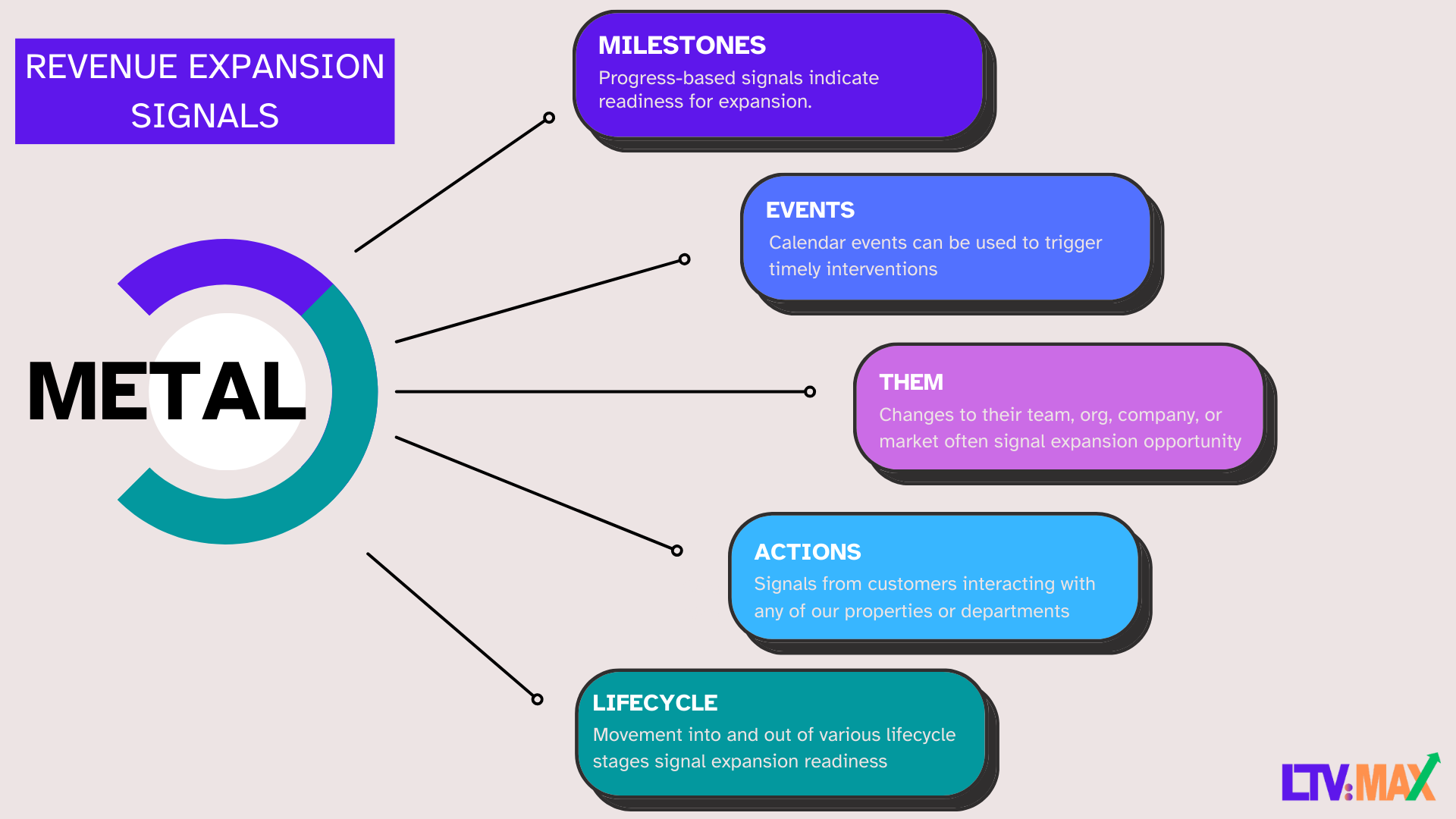
The Five Signals
M: Milestones
Progress-based signals. The customer achieved something real with what they bought: first result shipped, first workflow live, first quarter of numbers produced. Milestones are the strongest readiness channel there is, because achievement is what earns the next thing. This is the channel the milestone map is built from.
E: Events
Calendar signals. Renewals approaching, budget cycles, planning seasons, scheduled business reviews. Events are the only channel you can see coming a quarter away, which makes them the natural triggers for timely intervention. Nothing about the customer changed; the calendar arrived, and the calendar is when money is already in motion.
T: Them
Changes to who they are. Their team, their org, their company, their market: a new leader arrives, a hiring wave lands, funding closes, an acquisition goes through, their industry shifts under them. When Them changes, the account you originally sold no longer exists. The new one has new needs, and it never fills out a form to tell you so.
A: Actions
Interaction signals, from every property and every department, not just the product. Usage crossing a line, yes. But also the pricing page visit, the support thread question that's really a buying signal, the webinar they showed up to, the thing they asked their AM on a routine call. Actions are the channel most companies watch a tenth of and believe they're watching all of.
L: Lifecycle
Stage movement. The customer moves from onboarding into adoption, from adoption into maturity, from maturity toward renewal or expansion or drift. The movement itself is the signal, in both directions, because what a customer is ready for depends on where they are, and readiness at one stage is noise at another.
Why Five Channels and Not One
Because every channel alone produces false negatives, and false negatives are where latent revenue hides.
The usage-only company misses the customer whose team just doubled. The milestone-only company misses the renewal ninety days out. The account team watching for org changes misses the buying signal sitting in a support ticket. Every unwatched channel is a set of ready customers who look identical to unready ones, and revenue that nobody can see is revenue nobody collects.
Instrument all five and the questions that stump most executives become answerable. Which observable moments signal readiness: that's METAL. How many customers are approaching one right now: that's METAL with a counter on it. And orchestration is METAL with a playbook attached: each signal type wired to an offering, an owner, and a play.
From Client IP to Public Vocabulary
METAL has run inside client engagements since 2024. It gets named in public now for the same reason the rest of this vocabulary did: frameworks that only live inside engagements can't be checked, and I'd rather be checkable.
So check it against your own operation. Five channels. Ask which ones you instrument today. Most companies honestly answer one, partially. Every channel you don't watch is a queue of ready customers you can't see, and the money doesn't wait in line forever. Somebody else's calendar event is coming for them too.
Where does your company stand? Take the Latent Revenue Test: the six questions, self-served. Ninety seconds, no email required.
Lincoln Murphy formally named and popularized Customer Success starting in 2010 and has spent 15 years connecting it to expansion revenue and commercial outcomes. Read The Premise.